The Biggest Mistake Job Seekers Make (And How to Avoid It)
Job Search Strategy
General Career Advice
My client, Joe, approached me after being made redundant from his role as Executive Counsel in an employment law firm.
Like many job seekers, his entire job search strategy revolved around one platform: SEEK.
Each day he checked the site and applied for roles that appeared relevant. He was putting in a fortune of effort, but his search was entirely dependent on what happened to appear on a single job board.
We’ll get back to Joe’s story a bit later.
Over the years I’ve asked hundreds of job seekers the same question:
How are you searching for your next role?
Almost every time the answer is the same.
“I’m looking on SEEK.”
And honestly, that makes sense. SEEK is one of the most well-known job boards and it’s where many opportunities appear.
But this response often reveals something important.
In many cases, it means that a jobseeker’s entire job search strategy relies on one source.
And because so many people use that same source, it becomes a highly competitive environment. Thousands of candidates may be applying for the same role in exactly the same place.
Which raises an interesting question:
Would a job search strategy with more depth and breadth bring better results?
In most cases, the answer is yes.
I’m not sure if you realise that up to 70% of roles are filled through networking and the hidden job market.
How Most Job Seekers Actually Search
Most job seekers fall into a very similar pattern.
They register on job boards, receive alerts in their inbox and apply to roles as they appear. Applications are written, resumes are modified and hours are spent completing online forms.
On the surface, this can feel productive.
But I often meet people who have been doing this for months without seeing any results.
I’ve coached job seekers who have submitted hundreds of applications with little or no response. Evenings and weekends are spent tailoring applications, yet nothing seems to move forward.
It’s incredibly frustrating and discouraging.
Some people continue using this method because it worked for them in the past. Others simply don’t know what else to try.
Either way, the effort can start to feel like time disappearing down a deep, dark hole.
The Hidden Metric Most Job Seekers Ignore
One thing most job seekers don’t track is something called, “hit rate”.
Hit rate is simply: Number of interviews ÷ Number of applications
For example:
50 applications → 2 interviews = 4% hit-rate
10 applications → 3 interviews = 30% hit-rate
Many people focus on how many applications they submit.
But very few stop and ask:
“Is this approach actually working?”
Without measuring results, it’s easy to keep repeating a strategy that isn’t producing outcomes.
The Iceberg Most Job Seekers Never See
Another reason job boards can limit results is that they represent only a small portion of the overall job market.
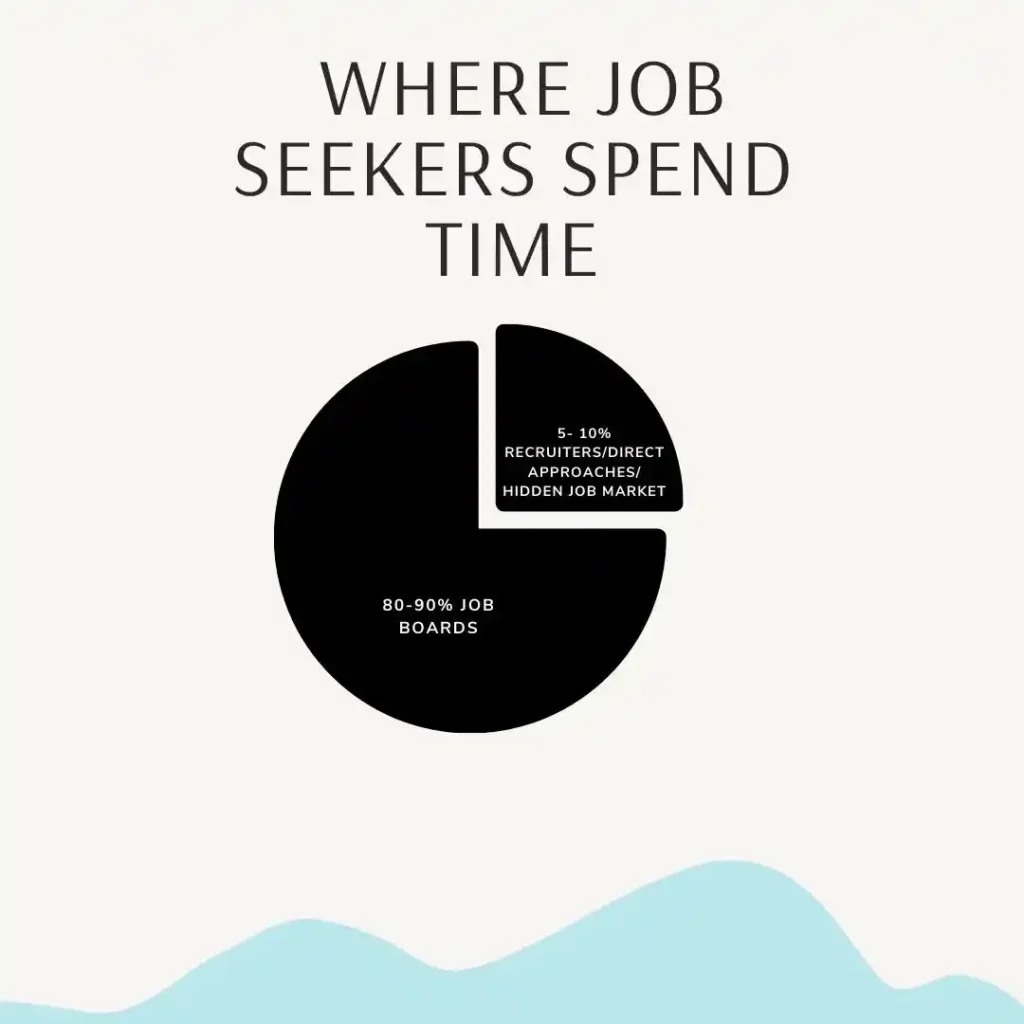
Most job seekers spend 80–90% of their time searching on commonly known job boards.
But advertised roles are only the visible part of the market.
Think of it like an iceberg.
The small tip above the water represents what is visible.
But the majority of the iceberg sits below the surface.
The same is true for jobs.
A large number of roles are filled through what is often called the hidden job market. These are roles that are never publicly advertised. Instead, they are filled through networking, referrals, recruiters or internal conversations.
Some estimates suggest that around 70% of roles come from this hidden market.
When job seekers focus only on job boards, they are essentially searching just the tip of the iceberg.
Why a Holistic Job Search Strategy Works Better
A more effective approach is to build a holistic job search strategy.
This means using multiple channels rather than relying on just one.
For example:
Job boards
LinkedIn networking
Recruiters
The hidden job market
This doesn’t mean abandoning SEEK, it is still a very useful job board.
But it should be one part of your strategy, not the entire strategy.
A broader approach creates more visibility, more conversations and more opportunities - including roles that may never appear in an advertisement.
Back to Joe
So, after we discussed how I could broaden his options, Joe and I expanded his strategy.
He began speaking with recruiters, reconnecting with people in his network and broadening his search beyond just one or two job boards.
Two months later, he secured a permanent role with an employer of choice.
His skills hadn’t changed.
What changed was the way he searched.
Laura’s Experience
Another client of mine, Laura, is a Senior Brand Manager.
She decided to look for a new role after significant changes in her organisation created a mismatch with her values.
Her job search initially relied on the job alerts she received after registering on three job boards.
Soon after we started working together, she shifted to a more holistic approach.
She began building new connections, holding information interviews and using LinkedIn much more strategically.
Within two months she secured a role in an environment aligned with collaboration, growth and family values.
Today she tells me she couldn’t be happier.
The Emotional Side of Job Searching
A job search isn’t just a practical process.
It’s also an emotional one.
You might be looking for a new role because you decided it was time for a change.
Or the change may have been forced upon you through redundancy or organisational restructuring.
Either way, it’s a transition.
And transitions rarely follow a straight path.
Psychiatrist Elisabeth Kübler-Ross developed a model describing the emotional stages people experience during major change. Originally linked to grief, it has since been adapted in business to the change curve.
During a job search you may experience phases such as:
denial
frustration or anger
exploration
acceptance
meaning
You might not go through every stage, and you may move backwards and forwards between them.
That’s completely normal.
Recognising this can help you understand your experience and protect your wellbeing during the process.
Why Strategy Matters More Than Volume
Many job seekers work incredibly hard.
They spend hours writing applications and modifying resumes for multiple roles.
But if those applications are all going into the same highly competitive space, the results may remain limited.
Continuing to repeat the same approach without results can be exhausting.
At some point it becomes important to recognise that persisting with an unsuccessful strategy is simply wasting precious time.
A more balanced approach opens the door to opportunities many job seekers never access.
A Final Thought
Most of my clients are surprised by where their eventual role comes from.
Often it isn’t the job board they relied on the most.
Instead, it might be:
someone they spoke within their network
a recruiter who remembered them
a conversation that opened an unexpected door
When you expand your approach, you expand your opportunities.
Take a moment to reflect on your current job search.
Ask yourself:
Where am I spending most of my time?
Is that approach actually producing results?
What other methods could I explore?
Most job seekers are surprised when they realise how much of their effort is focused in just one place.
And when they expand their approach, new opportunities often appear from unexpected sources.
Reading about tips for avoiding mistakes as a Job Seeker may be helpful, but nothing can top having an expert in your corner. If you're ready to engage a Career Coach for individualised support as a job seeker, take a look at our Job Search Strategy services for individuals here, or contact us to book your first coaching session.
Consultations are tailored made for your specific needs. You could be at any stage of your career
2
WORKSHOPS
Outcome Coaching offers individuals and organisations a number of individual workshops ranging from Resume development to Offer and Negotiation. These will take you to the next level!
3
SELF PACED TRAINING
Take a comprehensive step-by-step program if you are committed to securing your next role
Reading about tips may be helpful, but nothing can top having an expert in your corner. If you're ready for individualised support to reinvent your career, take a look at our services for individuals or contact us (discover session link) to book your first coaching session.
More General Career Advice Job Search Strategy Articles
My client, Joe, approached me after being made redundant from his role...
Refresh Your Career With
Expert Support
Outcome Coaching is a Career Coaching service that educates, equips and empowers individuals with the skills they need to succeed and advance their careers